

What will be the shape of the mediated reality to come? Will it be a single metaverse? A physical reality integrated with ambient technology? Or will the bubble burst, and we will head towards a post-digital era?
InterReal argues that the most probable outcome, in the near future, will not be the identification of a clear avenue, but rather a multiplication of “realities”: a Media Multiverse. This multiverse encompasses all sort of media-generated realities, from those of immersive Virtual Reality (VR), to the layers of Augmented Reality (AR) visualized over the physical world, and to the permanent worlds of online digital games. At the centre of the semiotic workings of the multiverse are mechanisms of interreal translations: specific forms of intersemiotic translation that transfer objects, spaces, or subjects across realities.
InterReal aims to establish a new approach to study and understand translations between different “realities”, and how they could influence our future. The project objectives revolve around the advancement of our empirical understanding of interreal translations, our methodological capacity to approach them and the creation of a theoretical framework to understand the media multiverse. To do so, we propose a combination of methods and approaches from translation studies and speculative research. The first, will provide us with a detailed understanding of the inner mechanisms of interreal translations (in terms of participants, products, processes and contexts), while the second will offer a critical look to the present opportunities and future possibilities related to the development of the media multiverse.
InteReal is a frontier research project for it determines a new object, asks new questions about it, and answers them within a new methodological and theoretical framework. It will pave the way for the initiation of a new field of research: Media Multiverse studies, which will gain relevance and importance as our mediascape becomes increasingly complex, multifaced and fragmented.

WHAT
The future of human communication is multiversal. Despite discussions of a single metaverse, our mediascape is increasingly fragmented and structured around different alternative realities (digital, virtual, augmented…).
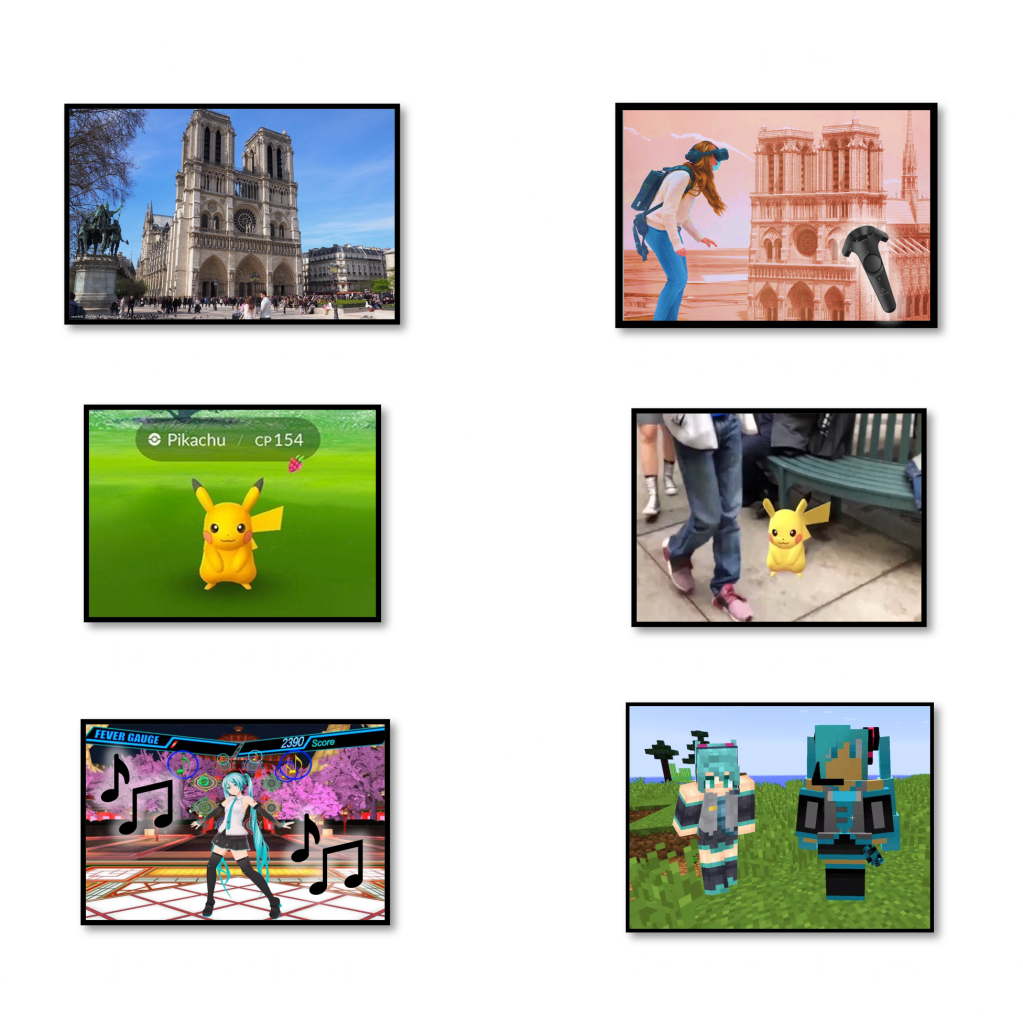
Objects, spaces, and subjects circulate across these realities, thanks to processes of modelling and digitization often oriented to create “copies” with characteristics similar to the originals – within the possibilities of the new medium. Understanding these processes, the strategies behind them, and the semiotic mechanisms involved is one of the important challenges of our time. To meet this challenge, I propose a novel approach: to study the processes of circulation between realities as a form of translation.Translations are traditionally articulated as interlingual (between natural languages), intralingual (within a language) and intersemiotic (between semiotic systems, for example intermedia adaptation) (Jakobson 1959). InterReal explores interreal translations (a specific form of intersemiotic translation): the process of rendering a certain object, space, or subject from one reality (source) into another (target) while preserving its meaning, key characteristics, and communicative intent with the aim to maintain a measure of equivalence between the two, despite large spaces of untranslatability (Thibault, forth.). An example can be the recreation of a heritage site in Immersive Virtual Reality (VR). The space is scanned, and the data are used to reproduce it in VR in a way that is faithful to its key characteristics. The desire to preserve the original characteristics guides the choices of its translators in terms of technical solutions and design choices oriented towards an effect of “equivalence”.
WHY
We are increasingly surrounded by interreal translations: if today there are thousands of different media-generated realities, in the near future they will likely increase exponentially. Every human will exist and live across many of them, struggling to navigate them and to manage the translations of themselves and their belongings in this virtual Babbel. Spaces will multiply and become increasingly multilayered, different instances of the same artifacts will exist in different realities, our identities and personalities will increasingly become objects of multiple translations. Digital copies of our conversation patterns, of our memories, of our appearances will be used to create countless simulacra of ourselves. These changes cannot be accurately forecast, but we are able to anticipate them. Therefore, rapid, and swift scientific effort is required to develop the tools necessary to study this process. This will ultimately lead to understanding the dynamics of the emergence of the Media Multiverse and to map and investigate the potential benefits and risks that emerge from the dynamics of communication and translation across realities.
HOW
This can be achieved only with an ambitiously multidisciplinary approach. The discipline has long moved away from linguistic bias, and, with a series of “turns” (Snell-Hornby 2006) it expanded to multimedia, multimodal and even posthuman forms of translation. Marais (2019), a key innovator within TS, describes the field as a “translation complex” that proceeds by successive expansions rather than linearly. InterReal proposes a new expansion for TS focusing on translations between the realities of the emerging Media Multiverse. On the other hand, speculative research can offer a critical and creative perspective. Traditionally rooted in design and Human Computer Interaction (HCI), speculative research is ripe to be expanded to new fields of inquiry. InterReal will combine the two approaches into an innovative methodology that: 1) Applies TS methods to a new object of study and 2) Imports the methodological approach of speculative design from HCI into the field of translation. The ongoing techno-cultural revolution that is multiplying the realities in our mediascape makes such an approach timely, even urgent. In my work, I have probed the potential of such methodological combination in exploratory studies (Thibault 2021, in 2022), but these very preliminary results need to be developed, expanded, solidified, and applied boldly and extensively. InterReal the double ambition of advancing our knowledge (empirical, methodological, theoretical) on the topic and of breaking new ground to expand the research field of TS and of affine disciplines (semiotics, media studies, and more) and in general the digital humanities, towards multiversal research. It is a frontier research project for it determines a new object, asks new questions about it, and answers them within a new methodological and theoretical framework.
Mattia Thibault, Riku Haapineimi, Cansu Cetin Er, Selahattin Karagoz, Gustavo Moreira Kares, Mariam Tharwat, R. Prageeth Amarasinghe, Xinyan ‘Shelly’ Zhao
Thibault, M. (2024). Exploring Interreal Translation. MikaEL, 17(1), 155-171.

 InterReality